
Scalp micropigmentation (SMP) is a cosmetic tattoo that uses tiny dots of pigment to imitate short stubble or add the look of density. A hair transplant moves your own follicles, so real hair grows that you can cut and style. SMP can fade over time and need touch-ups, while transplanted hair normally keeps growing for life once established.
Here is how each one works, how long each lasts, who each suits, and why some people combine the two.
What is scalp micropigmentation?
SMP is a cosmetic tattoo for the scalp. A practitioner uses a fine needle to place tiny dots of pigment in the upper layers of the skin. From a normal distance, the dots look like short hairs just breaking the surface.
It is used in two main ways:
- The shaved-head look. Dots across the scalp imitate a closely buzzed head of hair, often with a defined hairline.
- Adding density. Pigment between existing hairs reduces the contrast between hair and scalp, so thinning looks less obvious.
No hair grows from SMP. It changes how the scalp looks, not how much hair you have. It is usually built up over a few sessions.
It is a visual effect, so distance and light matter. Up close or in harsh light, the dots can look flat, because there is no hair texture or movement.
How is a hair transplant different?
A transplant relocates living follicles from the donor area at the back and sides of the head into the thinning zones. Because it is your own hair, it grows. You can wear it long, short, swept back or cropped.
In DHI, each follicle is lifted out with a fine FUE punch and set straight into the thinning area with an implanter pen. It is done under local anaesthesia and needs no stitches. Discomfort is usually mild, with little or no pain.
The trade-off is time. Shedding of the transplanted hairs is common in the first weeks, and new hair usually appears from about three months. It takes around 12 months to see the full result.
Which lasts longer, SMP or a hair transplant?
A transplant lasts longer in the way that matters most: once established, transplanted follicles normally keep growing for life.
SMP usually lasts for years, but the pigment can fade or soften over time. Sun exposure, skin type and aftercare can all play a part, and the strong Dubai sun is worth bearing in mind. Many people book touch-ups to keep the look crisp.
Transplants have their own long-term caveat. The native hair around the transplant can still thin with age. Surgeons build that into the plan, and it is one reason some people add SMP later.
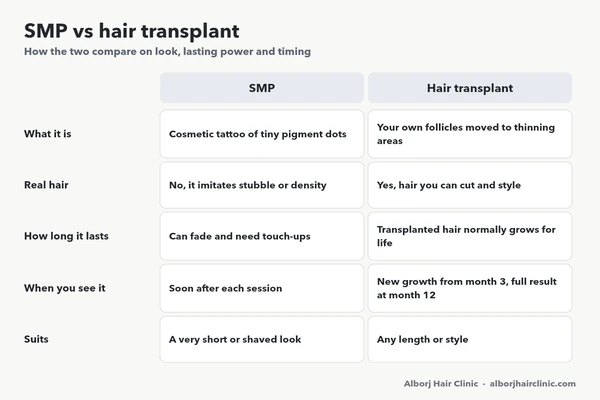
| SMP | Hair transplant | |
|---|---|---|
| What it is | Cosmetic tattoo of tiny pigment dots | Your own follicles moved to thinning areas |
| Real hair? | No, it imitates stubble or density | Yes, hair you can cut and style |
| How long it lasts | Can fade and need touch-ups | Transplanted hair normally grows for life |
| When you see it | Soon after each session | Growth from about 3 months, full result at about 12 months |
| Styling | Suits a very short or shaved look | Any length or style |
Who is SMP better suited to?
SMP tends to suit people who:
- Like a very short or shaved look and plan to keep it.
- Have extensive hair loss and too little donor hair for the coverage they want from a transplant.
- Want a visible change quickly, without waiting months for growth.
- Want to soften the contrast between thinning hair and the scalp.
The limits are worth knowing. SMP adds no volume or texture, so it is less convincing with longer hair. Choosing it also means committing to a short style and to touch-ups.
Who is a hair transplant better suited to?
A transplant tends to suit people who want real hair they can grow, style and change. It is usually most effective for patterned hair loss with plenty of healthy donor hair.
Hair loss is staged on the Norwood scale in men and the Ludwig scale in women. A consultation also looks closely at the donor area, since its density limits how much hair can be moved.
“SMP and a transplant do different jobs. A transplant gives you real hair that grows, while SMP changes how the scalp looks. Once people understand that difference, the choice usually becomes much clearer.”
Can you combine SMP with a hair transplant?
Yes, and some people do. A transplant restores real hair where it shows most, often along the hairline and front. SMP can then add the look of extra density between hairs or across the crown.
This can suit people whose donor hair is limited. The transplant goes where real hair makes the biggest difference, and SMP softens the contrast elsewhere.
If you are weighing up both, talk to your surgeon before booking SMP. The surgeon will want to assess the scalp and donor area clearly and can advise on how the two fit into one plan.
About Alborj Hair Clinic
Alborj Hair Clinic is a hair transplant clinic in Mazaya Centre, Al Wasl, Dubai. Its surgeon, Dr Dimitrios Ziakas, has 24 years of experience and has performed more than 4,000 hair transplant procedures. He is a member of the International Society of Hair Restoration Surgery (ISHRS) and uses the DHI (Direct Hair Implantation) technique.
The clinic also publishes before-and-after case studies on its website, which show how transplanted hair looks as it grows in over the year.
Frequently asked questions
Does SMP work with longer hair?
It looks most convincing with a very short cut. With longer hair, it can reduce the contrast in thinning areas, but it cannot add volume.
Which looks more natural, SMP or a transplant?
Both can look natural when done well. SMP works best as a short, shaved style, while a transplant grows real hair with its own texture and movement.
Can women have SMP or a hair transplant?
Both can be options for women. For a transplant, the surgeon looks at the pattern of thinning on the Ludwig scale and at the donor hair.
Will transplanted hair need touch-ups like SMP?
Transplanted hair normally keeps growing for life once established. Your other hair can still thin over the years, which is why the surgeon plans ahead.


